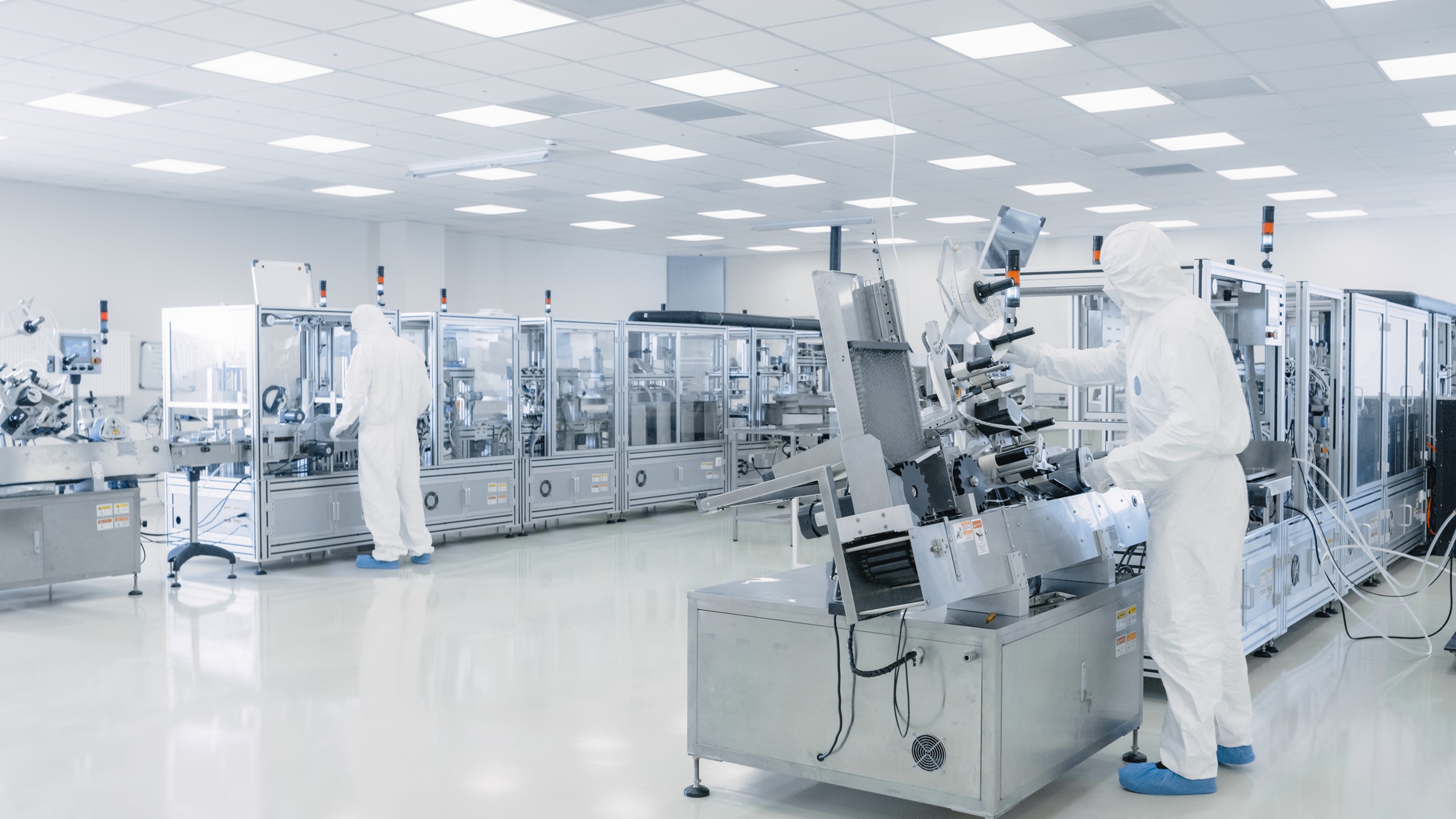

A pharmaceutical stability testing lab running 30 percent RH at 77°F sounds like a modest target until you work out what it means in dew point terms: 43°F. That puts the room dew point within 3 degrees of where refrigeration-based dehumidification starts losing reliability. To actively pull moisture out of the space, supply air dew points need to run 10 to 15 degrees below room conditions, pushing the required supply condition well below 40°F. For a GMP-classified area where humidity excursions require documented investigation, that's not an inconvenience; it's a compliance event.
Research environments cover one of the widest humidity ranges of any building type. A general analytical lab might run at 45 to 55 percent RH. A photolithography bay targets 35 to 45 percent RH depending on resist chemistry. A battery materials test chamber may need -40°F dew point.
Most laboratory HVAC projects focus on temperature control, air changes per hour, and filtration. Humidity often gets treated as a secondary parameter, until it isn't. Moisture absorption into hygroscopic materials, electrostatic discharge in spaces running below 40 percent RH, and microbial growth when conditions drift too wet result in failure modes that span every research discipline.
Standard air conditioning dehumidifies by cooling air below its dew point on a chilled coil. Moisture condenses and drains off, and the air leaves drier than it entered. Above about 45°F dew point (roughly 40 to 45 percent RH at typical lab temperatures), this works acceptably. Below that threshold, the physics become difficult.
To drive supply air to a lower dew point, the coil has to get colder. Parts of the coil surface drop below 32°F and frost accumulates. As frost builds, it insulates the coil surface and effective dehumidification capacity falls. Defrost cycles interrupt operation, and each one sends a brief slug of humid air back downstream. ASHRAE notes special precautions are required when cooling systems target dew points below 40°F. Labs targeting 30 percent RH or below at room temperature are asking their cooling system to operate at the edge of its physical capability, and humidity instability follows.
There's a more fundamental problem: the cooling system ties temperature control and humidity control to the same coil. A compressor cycle driven by sensible load — a researcher opens the door, solar gain shifts, equipment turns on — produces a corresponding shift on the latent side. The humidity setpoint moves every time the temperature setpoint does, and in a lab where both matter independently, that interdependence is the root of most excursion events.
A rotary desiccant wheel bypasses the freezing-point problem entirely. The wheel rotates slowly through two air streams: a process stream and a reactivation stream. In the process section, desiccant material in the wheel matrix absorbs water vapor from the passing air. On the reactivation side, hot air driven through the opposite face drives that moisture out and exhausts it to atmosphere. No coils, no condensation, no defrost cycles.
Process air leaving a desiccant wheel exits warm and dry. At high reactivation temperatures around 250°F, a properly sized rotary wheel can reduce incoming air from 56 grains per pound down to approximately 6 grains per pound in a single pass, reaching a dew point well below 0°F. The practical low-end limit for dry desiccant at atmospheric pressure is around -65°F dew point, with relative humidity maintainable as low as required.
A packaged rotary desiccant unit handles the targets most labs actually specify: stable 45 percent RH for general R&D, 30 percent RH for a pharmaceutical stability room, or -40°F dew point for a battery materials chamber. The required dew point is a design input, not a hard physical limit. Sizing depends on airflow, inlet conditions, reactivation temperature, and how much sensible heat the downstream cooling coil needs to remove after the wheel.
Because the desiccant system removes moisture through adsorption rather than condensation, temperature setpoint and humidity setpoint become independent design parameters. A lab running at 68 degrees Fahrenheit holds 30 percent relative humidity without asking the cooling system to operate any harder. A cold room at 40 degrees Fahrenheit maintains 35 percent relative humidity without driving the chiller to a coil temperature that would frost. Facility engineers can assign each system one job, size it for that job, and stop asking each to compensate for what the other can't do. In a research facility where temperature stability and humidity stability are both specified independently, that separation is the fundamental reason desiccant works where conventional systems fall short.
For pharmaceutical stability chambers and other applications requiring humidity tolerance tighter than plus or minus 2 percent, liquid desiccant systems can achieve plus or minus 1 percent relative humidity.
The conventional approach uses the cooling system to drive the process airstream to its dew point floor of 40 to 45 degrees Fahrenheit, reheating the supply air with hot gas or primary energy to reach delivery temperature, then adds a standalone desiccant system with separately purchased reactivation energy for the remaining moisture removal. Both systems serve the same space but aren't sized or controlled with each other in mind.
Desiccant Air Solutions builds hybrid desiccant units that integrate DX pre-cooling and desiccant dehumidification in a single package. The built-in DX coil reduces moisture content entering the wheel, which means a smaller wheel for the same outlet condition and lower reactivation energy. An internal desuperheater captures condenser heat from the unit's own refrigeration circuit and routes it to the reactivation airstream. That recovered heat drives desiccant regeneration without a separate fuel input, lowering net operating cost and allowing tighter dew point control at part load. When additional reactivation capacity is needed beyond recovered heat, the system can also draw from electricity, natural gas, steam, or hot water depending on what's available. The system modulates from zero to 100 percent of its moisture removal capacity through bypass damper and variable reactivation control, responding to dew point sensor feedback automatically, holding precise setpoints as occupancy, equipment loads, and outdoor conditions change without manual intervention.
Unlike catalog equipment designed for general-purpose dehumidification, Desiccant Air Solutions engineers each system for the specific process conditions and moisture loads of the application. Wheel media selection, pre-cooling capacity, reactivation temperature, and control logic are all configured for the target environment rather than selected from a standard product line.
System controls use PID logic with dew point sensor feedback to modulate moisture removal continuously. Standard configurations include BMS integration for remote monitoring, alarm management, and setpoint adjustment. For a small R&D lab, this architecture maps directly to a packaged unit format: a compact system combining the DX pre-cooling coil, rotary desiccant wheel, reactivation heater with internal heat recovery, and supply and exhaust fans in a single cabinet. Single-point installation, unified controls, and a defined performance envelope mean the building automation system doesn't need to coordinate two separate systems chasing one humidity target.
For typical humidity levels, air change requirements drive the CFM calculation. General R&D and analytical labs typically need 6 to 10 air changes per hour. Spaces with fume hoods or hazardous materials run 8 to 12 ACH. Room volume multiplied by ACH, divided by 60, gives minimum supply airflow in CFM. A 1,000 square foot lab with 10-foot ceilings at 10 ACH needs 1,667 CFM.
Moisture removal rate is the second key figure. Subtract the target moisture content in grains per pound from the inlet condition (outdoor design air from ASHRAE Fundamentals weather data for your climate location), multiply by CFM, and multiply by 0.000643 to get lbs/hr of required moisture removal. For a humid summer design day with outdoor air at 75°F and 60 percent RH (78 gr/lb) and a target lab condition at 70°F and 40 percent RH (45 gr/lb), a 1,667 CFM system needs to remove about 35.4 lbs/hr. Add roughly 0.3 lbs/hr per occupant, any wet process loads, and a 10 to 15 percent infiltration margin. That total removal figure, combined with the target dew point, determines equipment selection. Most small R&D labs land in the 1,500 to 2,500 CFM range for the dehumidification system. Battery spaces and very low dew point labs can require much more airflow to reach setpoint.
Laboratory humidity control is a process variable, not a comfort parameter. The consequences of getting it wrong range from failed stability studies to scrapped batches to regulatory findings. Standard HVAC runs out of capability well before many lab targets require, and adding refrigeration capacity to push lower is expensive and unstable at the limits. A dedicated desiccant system takes the latent load off the cooling plant entirely, letting each piece of equipment do what it's sized for. If you're sizing a new lab, retrofitting a space struggling with humidity stability, or designing a test chamber with precise dew point requirements, contact Desiccant Air Solutions at [email protected]. We size these systems from first principles.
Desiccant Air Solutions designs and builds custom dehumidification systems combining cooling and desiccant technology for demanding industrial applications. Contact us at [email protected].

2026
Moisture trapped in a lithium-ion cell during assembly doesn't show up until the cell is in service. By then it's a warranty claim, a field failure, or worse.... Read more

2026
Condensation grows mold. In a brewery, every surface that stays wet after sanitation is a potential colonization site, and... Read more

2026
Ice buildup on floors, product, and dock doors is a safety hazard and an operating cost. Cold storage dehumidification elimin... Read more