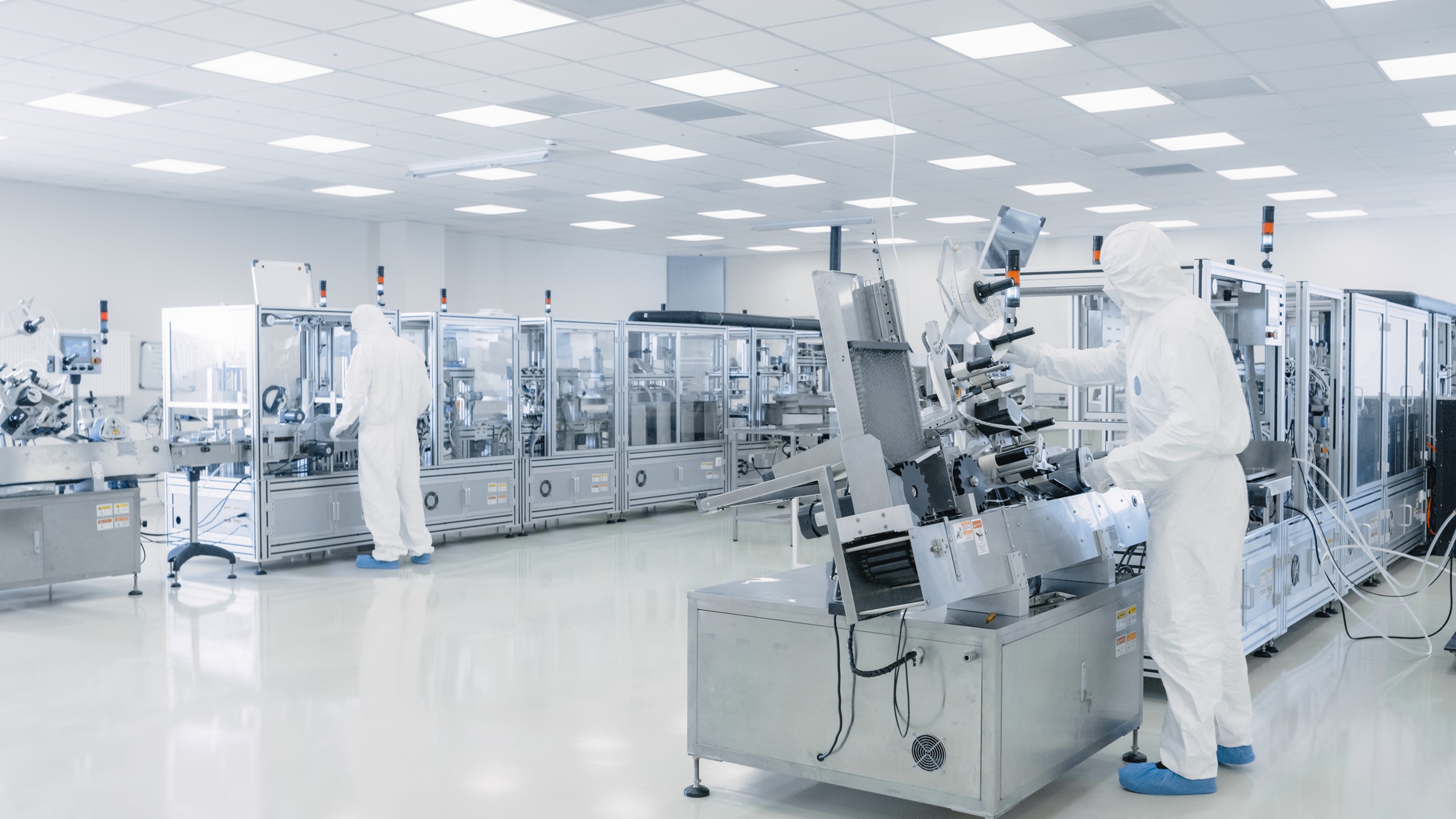

Lithium is hygroscopic. Cathode materials, electrolyte salts, and separator films all absorb water vapor on contact, and the consequences are permanent. Moisture reacting with lithium hexafluorophosphate electrolyte generates hydrofluoric acid, which corrodes cell internals, degrades capacity, accelerates self-discharge, and promotes the dendrite growth that leads to internal short circuits and thermal runaway. A cell assembled in air that's too wet won't fail immediately. It degrades faster than its specification predicts, fails prematurely in the field, and in some configurations presents a fire risk.
This isn't a comfort problem. It's a process integrity problem, and it requires atmospheric conditions that general-purpose HVAC cannot deliver. At room temperature, the relative humidity levels required in battery dry rooms are below 0.1 percent. The only technology capable of producing and sustaining those conditions is desiccant dehumidification.
The challenge is that not every step in lithium-ion manufacturing demands the same dew point. Electrode mixing tolerates conditions that would destroy an electrolyte filling operation. Designing a dry room as a single uniform environment wastes energy. The practical approach is staging: match the dew point to each process step and configure the dehumidification system accordingly.
Lithium-ion cell manufacturing follows a sequence of moisture-sensitive steps, each with its own atmospheric requirement. The table below maps each step to its target dew point, the system configuration needed to reach it, and the reason that dew point matters.
| Process Step | Dew Point Target | System Configuration | Why It Matters |
|---|---|---|---|
| Electrode slurry mixing | -20 to -30°F | Single-stage desiccant with DX pre-cooling | Binder and active material absorb moisture during mixing, reducing slurry consistency and electrode adhesion |
| Electrode coating and drying | -30 to -40°F | Single- or two-stage desiccant with pre-cooling | Residual moisture in the electrode film causes delamination and inconsistent porosity after calendering |
| Cell assembly (stacking, winding, tab welding) | -40 to -50°F | Two-stage desiccant with DX pre-cooling | Exposed electrode edges and separator layers absorb moisture that becomes trapped inside the finished cell |
| Electrolyte filling | -50 to -60°F | Two-stage desiccant, maximum DX pre-cooling | Electrolyte reacts with water vapor on contact, generating hydrofluoric acid and gas that compromise cell performance and safety |
| Formation cycling | -20 to -30°F | Single-stage desiccant | Outgassing during initial charge-discharge cycles releases moisture; moderate control prevents reabsorption |
Electrode slurry mixing is the entry point. Active materials and binders are blended with solvents in a controlled atmosphere. Moisture contamination at this stage compromises slurry viscosity and electrode adhesion, but the dew point requirement is moderate: -20 to -30 degrees Fahrenheit, achievable with a single desiccant stage and DX pre-cooling.
Electrode coating and drying raises the bar. The wet slurry is applied to current collector foils and dried in-line. Residual moisture trapped in the electrode film causes delamination and inconsistent porosity after calendering. Dew points of -30 to -40 degrees Fahrenheit are typical, and some lines use a second desiccant stage depending on ambient conditions and ventilation loads.
Cell assembly — stacking, winding, and tab welding — exposes electrode edges and separator layers to the room atmosphere for extended periods. This is where moisture absorption becomes permanent: once the cell is sealed, whatever moisture is inside stays inside. Target dew points of -40 to -50 degrees Fahrenheit require two desiccant stages with DX pre-cooling upstream.
Electrolyte filling demands the lowest dew points in the process, -50 to -60 degrees Fahrenheit. The electrolyte itself is extremely moisture-sensitive. Even brief exposure to inadequately dried air degrades the salt, generates gas, and introduces the hydrofluoric acid that corrodes cell internals over the cell's service life. Maximum DX pre-cooling ahead of two desiccant stages is the standard configuration.
Formation cycling, the final step, brings requirements back to -20 to -30 degrees Fahrenheit. Cells are charged and discharged for the first time, generating outgassing that releases residual moisture. Moderate dew point control prevents reabsorption during this phase.
Reaching -40 degrees Fahrenheit dew point with a single desiccant wheel is possible but inefficient. Reaching -60 degrees Fahrenheit with one wheel is impractical. Staged systems solve this by dividing the moisture removal across multiple steps, each optimized for its portion of the load.
In a single-stage configuration, DX pre-cooling chills the incoming air, condensing a large fraction of its moisture on the refrigeration coil before the air enters the desiccant wheel. This reduces the grain load the wheel must handle and allows the wheel to operate at a lower reactivation temperature. A single stage with pre-cooling can deliver supply air at -20 to -40 degrees Fahrenheit dew point depending on inlet conditions and wheel media.
In a two-stage configuration, the first wheel reduces moisture to an intermediate level, and the second wheel drives it to the final target. DX pre-cooling upstream of the first wheel remains critical because every grain of moisture removed by condensation is a grain the desiccant wheels don't need to adsorb, and condensation is cheaper per grain than adsorption.
The energy advantage of this approach comes from heat recovery. The DX refrigeration circuit rejects heat through its condenser. A desuperheater captures that rejected heat and routes it directly to the desiccant reactivation airstream within the same unit. This is recovered energy that would otherwise be wasted. When additional reactivation capacity is needed beyond what the desuperheater provides, the system draws from electricity, natural gas, steam, or hot water depending on the facility's available energy sources.
Wheel media selection follows the dew point target. Silica gel wheels perform well at moderate dew points (-20 to -40 degrees Fahrenheit) and tolerate a wide range of reactivation temperatures. Molecular sieve wheels are required for ultra-low dew points (-40 to -60 degrees Fahrenheit) because their crystalline structure provides higher adsorption capacity at very low moisture concentrations.
Desiccant Air Solutions engineers each system for the specific process conditions and moisture loads of the application. Wheel media, pre-cooling capacity, reactivation temperature profiles, staging configuration, and control logic are all configured for the target environment rather than selected from a standard product line. This application-specific approach is what separates an engineered dry room solution from catalog equipment.
The dehumidification equipment can only hold the dew point if the building envelope cooperates. In battery dry rooms, the dominant moisture source is often not the process itself but the boundary between the dry room and the surrounding facility.
A single poorly managed airlock can overwhelm the dehumidification system. Each time an airlock cycles, it exchanges a volume of dry room air with ambient air. At high traffic rates during production shifts, this infiltration load could exceed all other moisture sources combined. Airlock pressurization, interlocked doors preventing both from opening simultaneously, and sticky mat entry protocols are prerequisites to efficient operation.
Gowning rooms and material transfer ports are additional moisture entry points. Personnel entering the dry room carry moisture on their skin, clothing, and breath. At low dew points, even moderate occupancy represents a measurable load. ASHRAE data for light work activity (standing and walking) indicates approximately 0.2 to 0.3 pounds of moisture per hour per person. Size the system for actual peak occupancy, accounting for PPE protocols that reduce moisture release from skin.
Pressurization strategy matters. The dry room must maintain positive pressure relative to all adjacent spaces so that air leakage flows outward, not inward. Continuous makeup air to sustain that pressure differential adds to the dehumidification load but prevents uncontrolled infiltration through gaps, penetrations, and door seals.
Controls tie the system together. PID logic with dew point sensor feedback modulates moisture removal continuously, adjusting reactivation energy and wheel speed to match the real-time load. Standard configurations include BMS integration for remote monitoring, alarm management, and setpoint adjustment. Automotive OEM qualification programs typically require continuous dew point data logging as a manufacturing record, and the control system must support that documentation.
At gigafactory scale, dry room energy is a major operating cost. A large cell assembly floor with multiple dry room zones could carry several megawatts of installed desiccant reactivation heating load. The design of the dehumidification system directly affects the manufacturing economics of every cell produced.
Staged DX pre-cooling with heat recovery delivers the lowest energy cost per unit of moisture removed. Condensation on the DX coil handles the bulk moisture load cheaply. The desuperheater recovers that refrigeration circuit's reject heat for reactivation at no additional energy input. Only the gap between recovered heat and total reactivation demand requires purchased energy.
Modulation matters at production scale. Systems that can reduce output from full capacity to near-zero through bypass damper control and variable reactivation avoid the energy waste of constant-output operation. Weekend shutdowns, shift changes, and seasonal ambient variation all create conditions where the dry room needs less dehumidification than peak design. A system that modulates smoothly tracks the load and cuts energy proportionally.
Electric-only reactivation without DX pre-cooling or heat recovery is viable at small scale, where simplicity outweighs operating cost. At production volumes measured in gigawatt-hours annually, the integrated approach — staged pre-cooling, desuperheater heat recovery, and supplemental reactivation from the most economical available source — is the path to sustainable dry room operating costs.
Contact Desiccant Air Solutions at [email protected] to discuss dry room sizing, desiccant stage configuration, and heat recovery integration for your facility.
Desiccant Air Solutions designs and builds custom dehumidification systems combining cooling and desiccant technology for demanding industrial applications. Contact us at [email protected].

2026
Moisture trapped in a lithium-ion cell during assembly doesn't show up until the cell is in service. By then it's a warranty claim, a field failure, or worse.... Read more

2026
Condensation grows mold. In a brewery, every surface that stays wet after sanitation is a potential colonization site, and... Read more

2026
Ice buildup on floors, product, and dock doors is a safety hazard and an operating cost. Cold storage dehumidification elimin... Read more