
Refrigeration handles sensible load well. Below 45°F dew point, it handles latent load poorly. That's where desiccant dehumidification takes over.
talk to an engineerThis works well above about 45°F dew point. Below that threshold, the coil temperature required to condense moisture drops below freezing. Ice forms on the coil, airflow drops, efficiency collapses, and the system spends more time in defrost than in dehumidification.
That's the wall. And it's exactly where most industrial applications live: food processing, pharmaceutical manufacturing, cold storage, battery dry rooms. These processes need dew points that refrigeration alone can't reliably deliver.
This process is temperature-independent. Desiccant systems work efficiently at sub-freezing temperatures where refrigeration cannot; there are no coils to frost, no condensate to manage, and no efficiency cliff at 45°F.
The desiccant material is regenerated continuously using heat, allowing continuous operation at stable dew points regardless of ambient conditions.
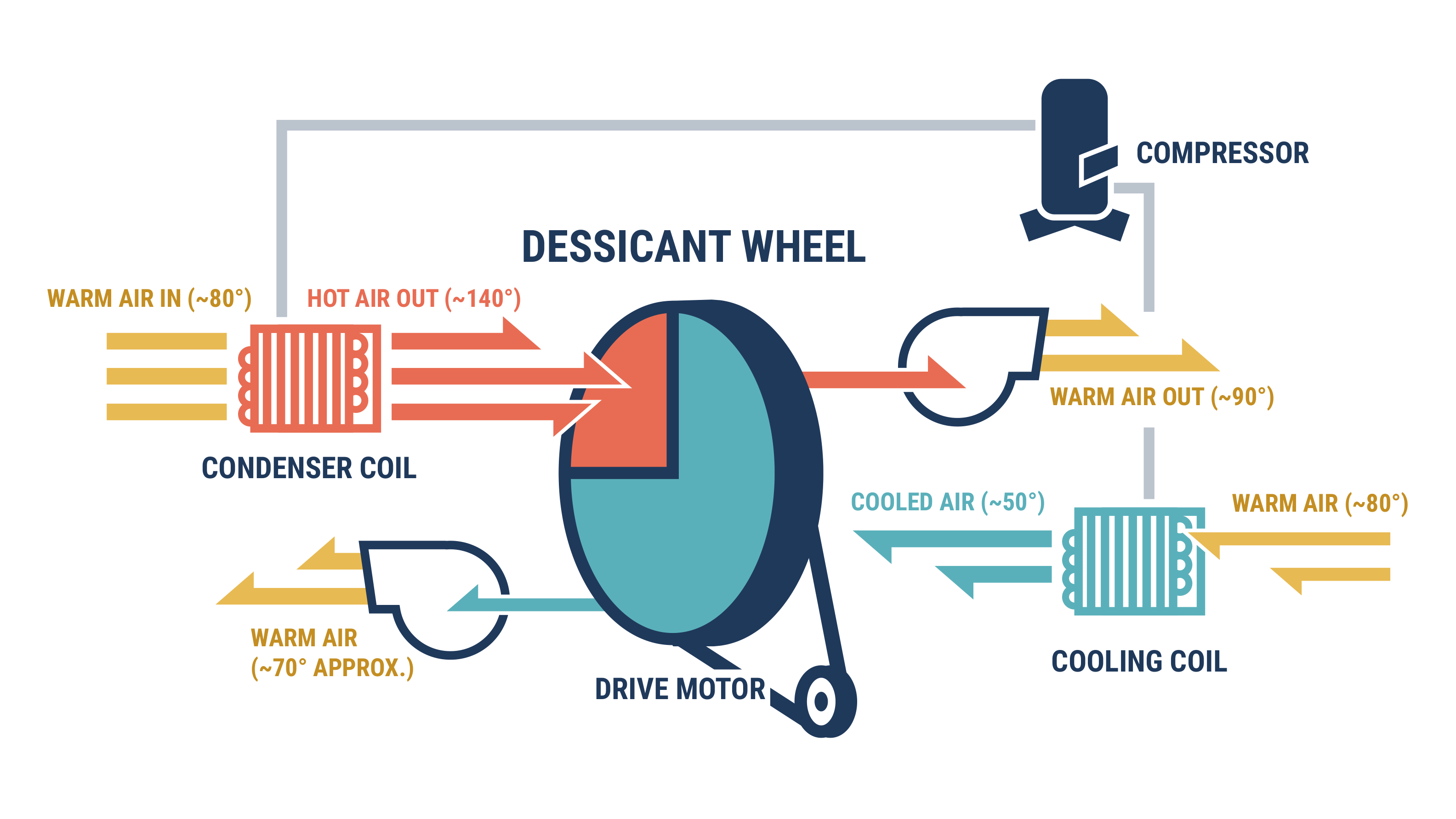
Refrigeration handles the sensible load (temperature reduction) efficiently. Desiccant handles the latent load (moisture removal) below the refrigeration threshold.
A hybrid system integrates both into a single optimized unit to reduce energy consumption, minimize footprint, and deliver better total performance than either technology alone.