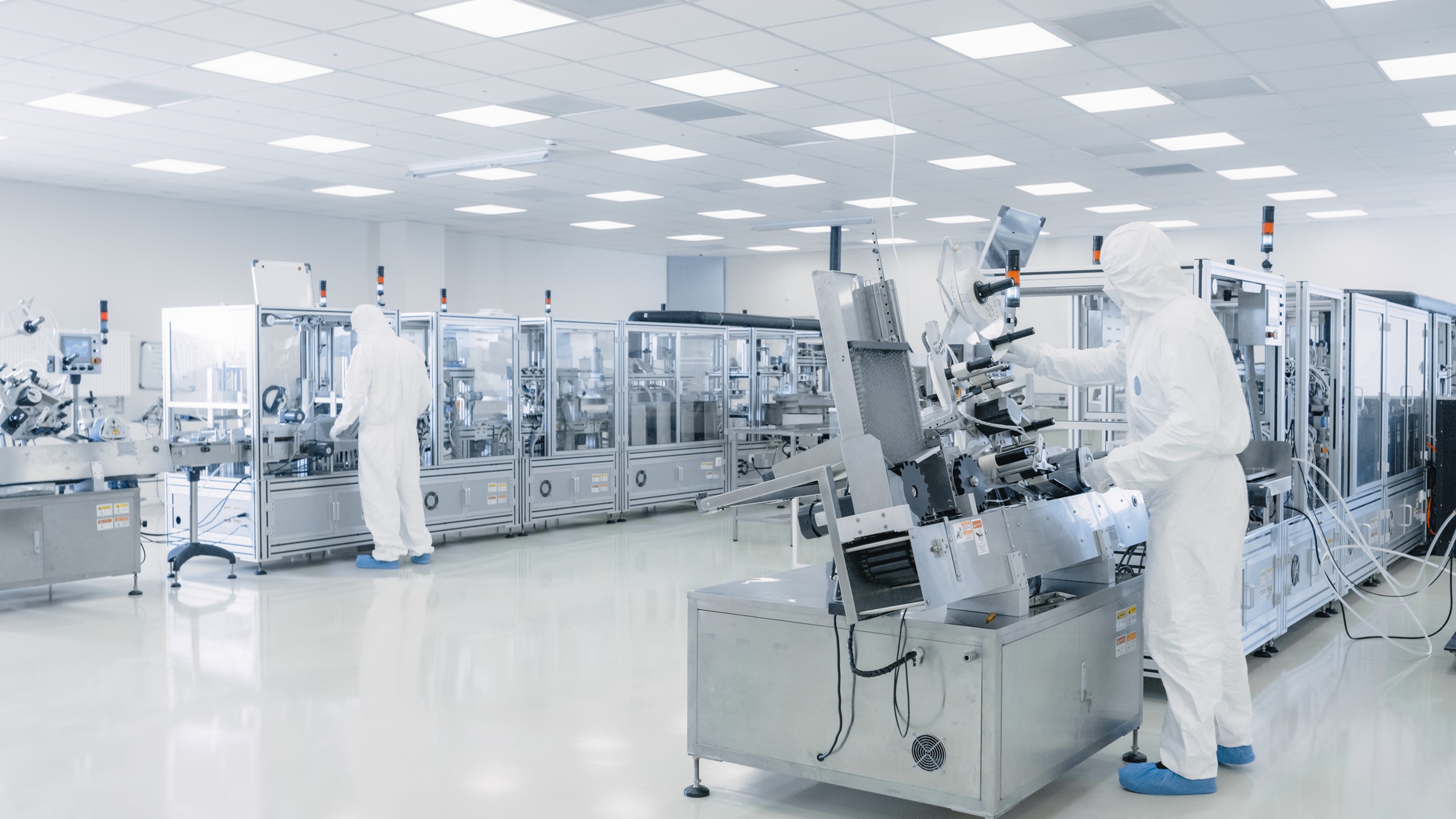

Pharmaceutical manufacturing operates under a simple constraint: moisture is almost always the enemy. Film coating requires controlled relative humidity to prevent picking, sticking, orange peel, and film bridging between tablets. Hard gelatin capsule filling requires low moisture to keep shells from softening, sticking together, or changing weight. Tableting operations for moisture-sensitive active pharmaceutical ingredients require dry rooms where even a brief humidity excursion can cause capping, lamination, and failed hardness testing.
Each of these operations has its own target. Coating pans typically require 15 to 25 percent relative humidity during aqueous film coating to allow moisture to flash off the tablet surface between spray passes. Encapsulation lines run best at 20 to 35 percent relative humidity, with tighter tolerance for hygroscopic shells. Tableting and active pharmaceutical ingredient handling for the most moisture-sensitive compounds may require dew points well below 32 degrees Fahrenheit. These aren't arbitrary numbers; they're process parameters with measurable product quality consequences when violated.
The enforcement framework is clear. cGMP regulations require HVAC systems to maintain process conditions consistently, and those conditions must be validated. A system holding humidity within specification 90 percent of the time creates a process that can't be validated. Humidity excursions that appear in batch records generate deviation investigations. Investigations that recur generate observations. The technical and commercial cost of inadequate humidity control goes well beyond the rejected batch.
Standard air handling systems are engineered to maintain temperature and provide ventilation. Humidity removal is a secondary effect of cooling: supply air at 55 degrees Fahrenheit at typical summer conditions produces a supply dew point around 53 degrees Fahrenheit, limiting the room to roughly 30 to 40 percent relative humidity at best. Pharmaceutical cleanroom environments add a complication: classified spaces require high air change rates, often 20 or more per hour, driven by contamination control rather than latent load management. Every air change replaces conditioned air with outdoor air that carries its full moisture load, and at 20 or more air changes per hour, the volume of humid outdoor air entering the system is substantial.
When a conventional air handler satisfies its sensible cooling setpoint and the compressor cycles off, latent control stops. In a manufacturing space with high personnel density, frequent material movement through airlocks, and process moisture from open coating pans, humidity rebounds within minutes. Reaching and holding 20 percent relative humidity with cooling alone requires pushing the coil well past the practical 40 to 45 degree Fahrenheit dew point floor. Even with hot gas or primary energy reheating the supply air back to delivery temperature on the process airstream, the coil can't reach the dew points film coating and sensitive processing require. The result is a system cycling between its floor condition and humidity rebound, with no stable path to target.
A rotary desiccant wheel removes moisture through adsorption rather than condensation. Process air passes through the hygroscopic wheel matrix and leaves at a dew point well below what a cooling coil can achieve at practical supply air temperatures. For pharmaceutical operations, performance targets range from 30 to 40 percent relative humidity for general manufacturing, to 15 to 25 percent for film coating, to dew points below 32 degrees Fahrenheit for moisture-critical active pharmaceutical ingredient processing. A desiccant system reaches all of these setpoints without the supply air temperatures that cause condensation problems on ductwork and building structure.
Because adsorption is independent of temperature, desiccant systems allow a fundamental separation of sensible and latent control that cooling-based systems can't replicate. The air handler manages temperature and ventilation. The desiccant system holds dew point. Neither depends on the other's load or cycling behavior. A room setpoint of 20 percent relative humidity at 68 degrees Fahrenheit can be held continuously regardless of how often the chilled water system modulates, across shift changes, weekend low-occupancy periods, and seasonal outdoor air swings.
For pharmaceutical applications requiring very tight humidity tolerances or high transient moisture loads, liquid desiccant systems offer additional advantages. A liquid desiccant system circulates a hygroscopic salt solution through a conditioner that simultaneously cools and dehumidifies in a single pass. Precision is a key benefit: liquid desiccant systems can hold humidity within plus or minus one percent relative humidity, which matters in coating and encapsulation operations where narrow process windows drive product quality. Liquid desiccant also handles peak transient loads well, such as the moisture surge after a washdown or cleaning cycle, because the solution's absorption capacity scales with concentration and flow rate rather than being fixed by wheel geometry. For facilities with low-grade waste heat available, the regenerator can operate at lower temperatures than a dry desiccant wheel requires, reducing energy cost.
ASHRAE Applications (Chapter 14) identifies pharmaceutical manufacturing as an application requiring continuous, precise humidity control beyond the capability of standard air conditioning. It distinguishes between spaces requiring comfort conditioning and spaces requiring process humidity control, and identifies desiccant dehumidification as the appropriate technology for the latter.
The standard approach uses the cooling system to overcool the process airstream to its practical dew point floor, reheating the supply air with hot gas or primary energy to reach delivery temperature, then adds a standalone desiccant system with separately purchased reactivation energy to reach the final target. Both systems serve the same building but operate independently.
Desiccant Air Solutions integrates the two into a single, self-contained design. Built-in DX pre-cooling drops the air temperature entering the desiccant wheel, reducing the moisture load the wheel must handle per pound of air. A smaller wheel operating at lower reactivation temperature delivers the same outlet dew point at lower energy cost than a wheel processing warm, humid air. On the reactivation side, an internal desuperheater recovers condenser heat from the unit's own refrigeration circuit and routes it directly to the reactivation airstream. When additional reactivation capacity is needed beyond recovered heat, the system can also draw from electricity, natural gas, steam, or hot water depending on the application. Where a facility has existing chilled water infrastructure, the system can also integrate with that plant as an alternative pre-cooling source. Either path produces a tighter dew point at lower net operating cost, with a single point of design accountability for the humidity performance that drives validated process outcomes.
Unlike catalog equipment designed for general-purpose dehumidification, Desiccant Air Solutions engineers each system for the specific process conditions and moisture loads of the application. Wheel media selection, pre-cooling capacity, reactivation temperature, and control logic are all configured for the target environment rather than selected from a standard product line.
System controls use PID logic with dew point sensor feedback to modulate moisture removal continuously. Standard configurations include BMS integration for remote monitoring, alarm management, and setpoint adjustment.
Pharmaceutical dehumidification sizing requires accounting for three distinct moisture sources: outdoor ventilation air brought in for cGMP air change requirements, personnel load from operators and quality staff, and process moisture from operations such as aqueous coating, open blending, and cleaning cycles. Outdoor ventilation air typically dominates in high-air-change-rate classified spaces.
A practical starting point: determine the required supply airflow from the air change rate and room volume, then calculate the moisture load. At 75 degrees Fahrenheit and 60 percent relative humidity, outdoor air carries 78 grains of moisture per pound. Supply air delivered at 15 percent relative humidity and 68 degrees Fahrenheit carries 15 grains per pound. The system must remove the difference, 63 grains per pound, across the full supply airflow. To calculate moisture removal in pounds per hour: multiply the grains-per-pound difference by the airflow in cubic feet per minute, multiply by 4.5, and divide by 7,000. At 1,000 cubic feet per minute with a 63-grain differential, that's approximately 41 pounds per hour of moisture removal, before adding personnel and process contributions.
| Process Area | Target RH | Dew Point Equivalent | Key Moisture Sources |
|---|---|---|---|
| Film coating | 15–25% | 10–35°F | Aqueous spray evaporation, personnel, outdoor air |
| Hard gelatin encapsulation | 20–35% | 25–40°F | Personnel, outdoor air, capsule moisture |
| Tableting (standard API) | 35–45% | 38–48°F | Personnel, outdoor air |
| Moisture-critical API processing | Below 10% | Below 32°F | Outdoor air, personnel, process |
| Finished product packaging | 30–45% | 35–48°F | Outdoor air, product off-gassing |
Size for the worst-case combination of outdoor conditions and process activity, not for average conditions. For coating operations, that means full personnel occupancy, simultaneous cleaning operations in adjacent spaces, and summer peak outdoor air. A system sized only for steady-state baseline conditions will be inadequate during peak production.
A well-designed desiccant system can modulate from zero to 100 percent of its moisture removal capacity through bypass damper and variable reactivation control, responding to dew point sensor feedback and changing process loads and outdoor conditions without manual adjustment. This is particularly valuable in pharmaceutical manufacturing, where validated processes require demonstrated control across the full operating envelope. Redundancy requirements in pharmaceutical manufacturing can be higher than in other applications: validated processes can't run during dehumidifier downtime without a deviation, so design for N+1 capacity where continuous humidity performance is required.
Pharmaceutical manufacturing humidity control isn't a comfort problem. It's a product quality problem and, directly downstream, a regulatory compliance problem. A desiccant dehumidification system designed to separate latent load management from sensible cooling, integrated with existing refrigeration infrastructure for reactivation heat recovery, delivers validated humidity setpoints continuously across the full range of process conditions and seasonal variation. The consequence of getting it right is a process that stays in specification. The consequence of getting it wrong shows up in batch records and investigation logs. Contact Desiccant Air Solutions at [email protected] to discuss sizing, system configuration, and control options for your facility.
Desiccant Air Solutions designs and builds custom dehumidification systems combining cooling and desiccant technology for demanding industrial applications. Contact us at [email protected].

2026
Moisture trapped in a lithium-ion cell during assembly doesn't show up until the cell is in service. By then it's a warranty claim, a field failure, or worse.... Read more

2026
Condensation grows mold. In a brewery, every surface that stays wet after sanitation is a potential colonization site, and... Read more

2026
Ice buildup on floors, product, and dock doors is a safety hazard and an operating cost. Cold storage dehumidification elimin... Read more