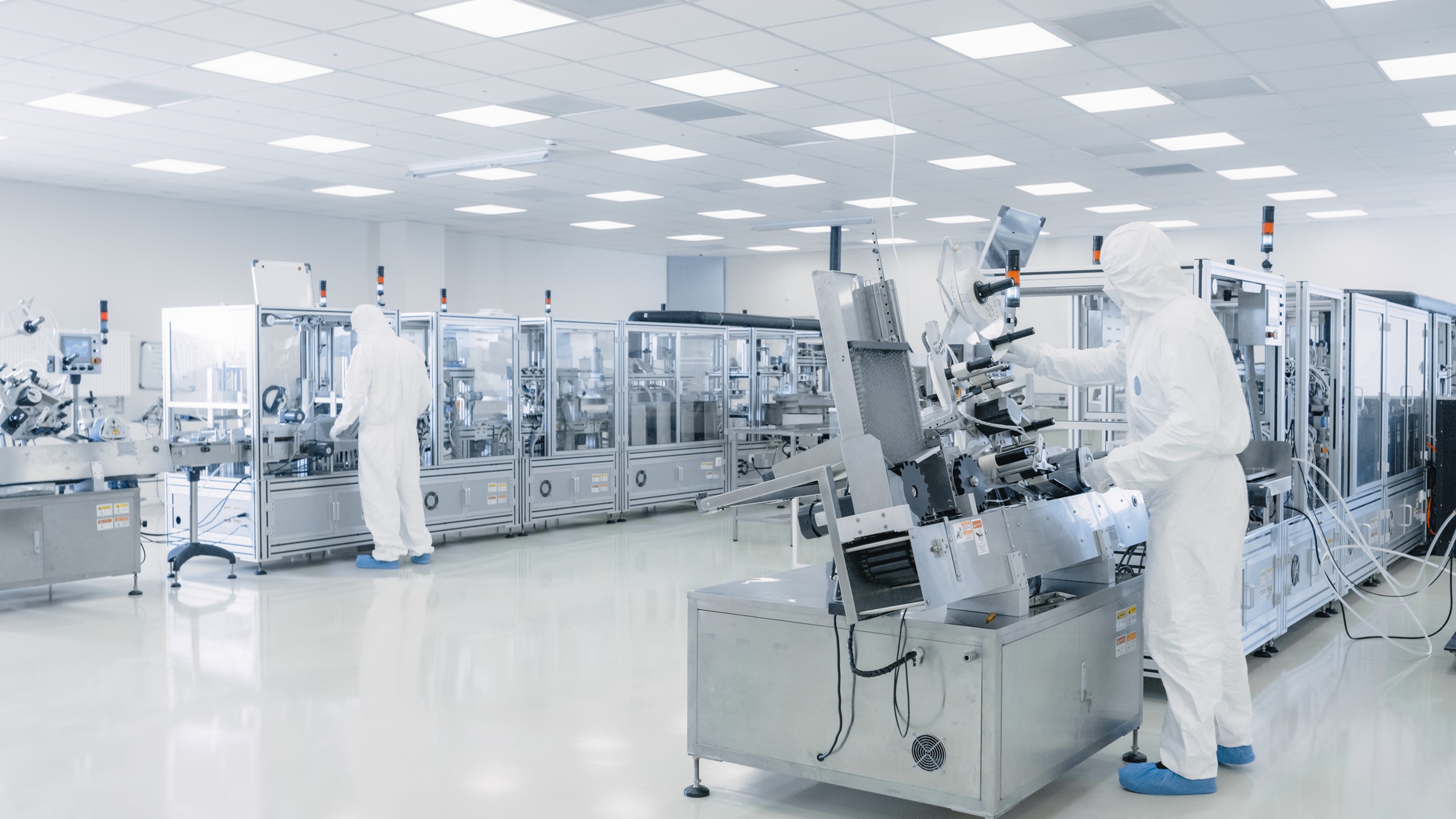

Food processing environments are among the most humidity-intensive industrial settings in any sector. Cooking, blanching, scalding, and washing operations continuously add moisture to the air. Cold storage transitions, refrigerated processing rooms, and temperature differentials between production areas and adjacent spaces create cold surfaces throughout the facility. When warm, moisture-laden production air contacts those cold surfaces, including refrigeration and process piping running throughout the building, condensation forms on ceiling structure, overhead conveyors, piping, and equipment. That condensation drips.
In a red meat or poultry plant, condensate dripping onto an exposed product line is a contamination event. The water itself carries bacteria from the surfaces it formed on: ceiling steel, structural supports, overhead piping, and mechanical equipment that may harbor Listeria, Salmonella, or other pathogens. A single droplet landing on exposed product introduces a contamination vector that can't be removed by downstream processing. USDA FSIS Sanitation Performance Standards (9 CFR 416) require that establishments maintain sanitary conditions and prevent product adulteration from insanitary conditions, including uncontrolled condensation. FSIS Notice 31-98 provides specific guidance classifying condensation as acceptable, controllable, or unacceptable depending on location and potential for product contact. Facilities that can't control condensation face Noncompliance Records (NRs), product holds, and potential enforcement action up to suspension of inspection, which shuts down the line. Most federally inspected establishments address condensation control as a prerequisite program under their Sanitation Standard Operating Procedures (SSOPs). Failure to maintain it is a regulatory finding, not a maintenance recommendation.
Beyond regulatory compliance, uncontrolled humidity degrades facility operating economics in ways the maintenance budget absorbs without connecting to a root cause. Overhead steel corrodes. Floor drains back up with condensate. Refrigeration systems work harder as condensation loads the evaporators in cold production areas. Sanitation chemicals applied to wet surfaces dilute and lose effectiveness. The humidity problem that generates a USDA finding is usually the same problem that's been inflating the maintenance budget for years.
Food processing facilities present a cooling system with an impossible job in many configurations. The spaces that require the lowest humidity are often the coldest: refrigerated cut rooms, chill coolers, and packaging areas operating at 35 to 45 degrees Fahrenheit. Conventional refrigeration removes moisture as a secondary effect of cooling the process airstream below its dew point, but in a 38 degree Fahrenheit cut room the practical dew point floor of 40 to 45 degrees Fahrenheit sits at or above the space temperature. Even with hot gas reheat available to manage supply air temperature, the coil's dehumidification capacity is near zero at those conditions. The refrigeration system is occupied holding space temperature. Moisture removal is largely absent.
The same physics that limits refrigeration performance in cold spaces creates a separate problem in the warm, high-moisture areas adjacent to them: scalding rooms, cooking areas, and wash-down zones. Moisture loads in these areas can be substantial, driven by steam, hot water, and direct product moisture release. A cooling-based dehumidification system sized for those loads would need to chill very large volumes of warm, humid air before distributing it into the space, producing supply air temperatures and volumes that conflict with food safety temperature requirements and create their own condensation risks on supply ductwork. Latent and sensible loads in food processing frequently point in opposite directions, and a system designed to manage one typically compromises the other.
Desiccant dehumidification addresses the food processing humidity problem without requiring cold supply air. A rotating desiccant wheel adsorbs moisture from process air continuously, delivering supply air at controlled dew points regardless of the space temperature or the moisture source. In a refrigerated cut room at 38 degrees Fahrenheit, the desiccant system can hold space dew point below the lowest surface temperature in the room, preventing condensation on evaporator coils, overhead structure, and cold equipment surfaces. In a warm processing area, the same technology removes moisture loads that would overwhelm a cooling-based system at that temperature.
The fundamental advantage in food processing is the separation of latent and sensible load management. The refrigeration system manages space temperature and product temperature. The desiccant system manages air moisture content. Neither system depends on the other's operating state. When the refrigeration system's evaporators defrost and briefly warm the space, dew point control doesn't lapse. When a product changeover brings warm product into a cold space, the desiccant system absorbs the moisture load rather than letting it reach condensation on cold surfaces above the line.
ASHRAE Applications (Chapter 12) identifies food processing and cold storage as applications requiring dedicated humidity control that cooling systems alone can't reliably provide. For facilities subject to USDA FSIS oversight, the connection between dew point control and regulatory compliance is direct: a system that maintains space dew point consistently below the coldest surface temperature in the production area satisfies the condensation-prevention requirement in a way that cleaning and monitoring alone cannot.
The standard approach treats humidity control as a separate system with its own energy budget, typically adding a standalone desiccant unit with electric or steam reactivation. That works, but it leaves energy on the table.
Desiccant Air Solutions builds hybrid desiccant units that contain their own DX pre-cooling coil and desiccant wheel in a single package. The DX coil pre-cools the incoming air, removing bulk moisture through condensation before the desiccant wheel handles the remaining load. An internal desuperheater recovers condenser heat from the unit's own refrigeration circuit and routes it directly to the reactivation airstream. When additional reactivation capacity is needed beyond recovered heat, the system can also draw from electricity, natural gas, steam, or hot water depending on the application. The result is a self-contained system that provides both cooling and dehumidification while recovering its own waste heat for reactivation, rather than drawing reactivation energy from a separate source. This integrated approach produces lower net operating cost than either a standalone desiccant unit with electric reactivation or a separate cooling system paired with independent dehumidification. The facility gets precise dew point control and some sensible cooling from a single piece of equipment with a single point of accountability for performance. The system modulates from zero to 100 percent of its moisture removal capacity through bypass damper and variable reactivation control, responding to dew point sensor feedback and changing production loads and sanitation recovery demands without manual intervention.
Unlike catalog equipment designed for general-purpose dehumidification, Desiccant Air Solutions engineers each system for the specific process conditions and moisture loads of the application. Wheel media selection, pre-cooling capacity, reactivation temperature, and control logic are all configured for the target environment rather than selected from a standard product line.
System controls use PID logic with dew point sensor feedback to modulate moisture removal continuously. Standard configurations include BMS integration for remote monitoring, alarm management, and setpoint adjustment.
Food processing dehumidification sizing begins with identifying the dominant moisture sources for each production zone, since different areas in the same facility can have radically different humidity profiles. Thermal processing areas (scalding, cooking, blanching) generate large moisture loads from open water surfaces and steam. Refrigerated processing areas generate moisture loads primarily from outdoor air infiltration through doors and airlocks, personnel, and product moisture release. Packaging areas have lower process moisture loads but require the most precise humidity control to protect product quality and shelf life.
A practical starting point for refrigerated production rooms: calculate the door infiltration load from the number of door openings per hour, the area and temperature differential of each opening, and the outside design conditions. Add personnel load at approximately 0.15 pounds of moisture per person per hour at low activity levels. Active line workers generate more, typically 0.2 to 0.3 pounds per hour depending on physical effort and space temperature. Sum the loads and convert to pounds per hour of moisture removal required. For a room at 38 degrees Fahrenheit with a dew point target of 32 degrees Fahrenheit, the system must hold space dew point at or below 32 degrees Fahrenheit continuously during production hours, peak personnel occupancy, and worst-case door traffic.
| Facility Area | Temperature Range | Target Dew Point | Primary Moisture Sources |
|---|---|---|---|
| Scalding / thermal processing | 100–160°F | Control RH below 80% | Steam, open hot water, product moisture |
| Refrigerated cut room | 35–45°F | Below 30°F | Personnel, door infiltration, product |
| Chill cooler / cold storage | 28–38°F | Below 25°F | Infiltration, product respiration |
| Packaging / labeling | 50–65°F | Below 40°F | Personnel, OA, product |
| Loading dock / staging | Ambient to 55°F | Below surface temp of coldest product | Door infiltration, outdoor conditions |
Size for the sanitation recovery event explicitly. After a wet sanitation cycle, a refrigerated processing room contains significantly more moisture than during steady-state production. The humidity load following sanitation can be two to three times the normal production load for 30 to 60 minutes. A system sized only for steady-state production will allow humidity to climb during sanitation recovery, potentially creating condensation and mold growth conditions before the next production shift begins.
Liquid desiccant systems offer a specific advantage for post-sanitation recovery. A liquid desiccant unit can remove substantially more moisture per unit of airflow than a dry desiccant wheel during high-load transient events, pulling the space down to target conditions faster. For facilities where sanitation recovery time directly limits production hours, liquid desiccant's higher moisture removal capacity during peak load events can translate to earlier production starts.
Condensation in a food processing facility is simultaneously a food safety problem, a regulatory compliance problem, and a facility maintenance problem with costs distributed across multiple budgets. A desiccant dehumidification system that holds space dew point below cold surface temperatures separates the humidity problem from the refrigeration system, recovers waste condenser heat for reactivation, and eliminates the condensation conditions that generate USDA findings and inspection reports. The investment in proper humidity control typically competes favorably against the combined cost of ongoing condensation-related maintenance, regulatory exposure, and product loss. Contact Desiccant Air Solutions at [email protected] to discuss sizing, system configuration, and control options for your facility.
Desiccant Air Solutions designs and builds custom dehumidification systems combining cooling and desiccant technology for demanding industrial applications. Contact us at [email protected].

2026
Moisture trapped in a lithium-ion cell during assembly doesn't show up until the cell is in service. By then it's a warranty claim, a field failure, or worse.... Read more

2026
Condensation grows mold. In a brewery, every surface that stays wet after sanitation is a potential colonization site, and... Read more

2026
Ice buildup on floors, product, and dock doors is a safety hazard and an operating cost. Cold storage dehumidification elimin... Read more